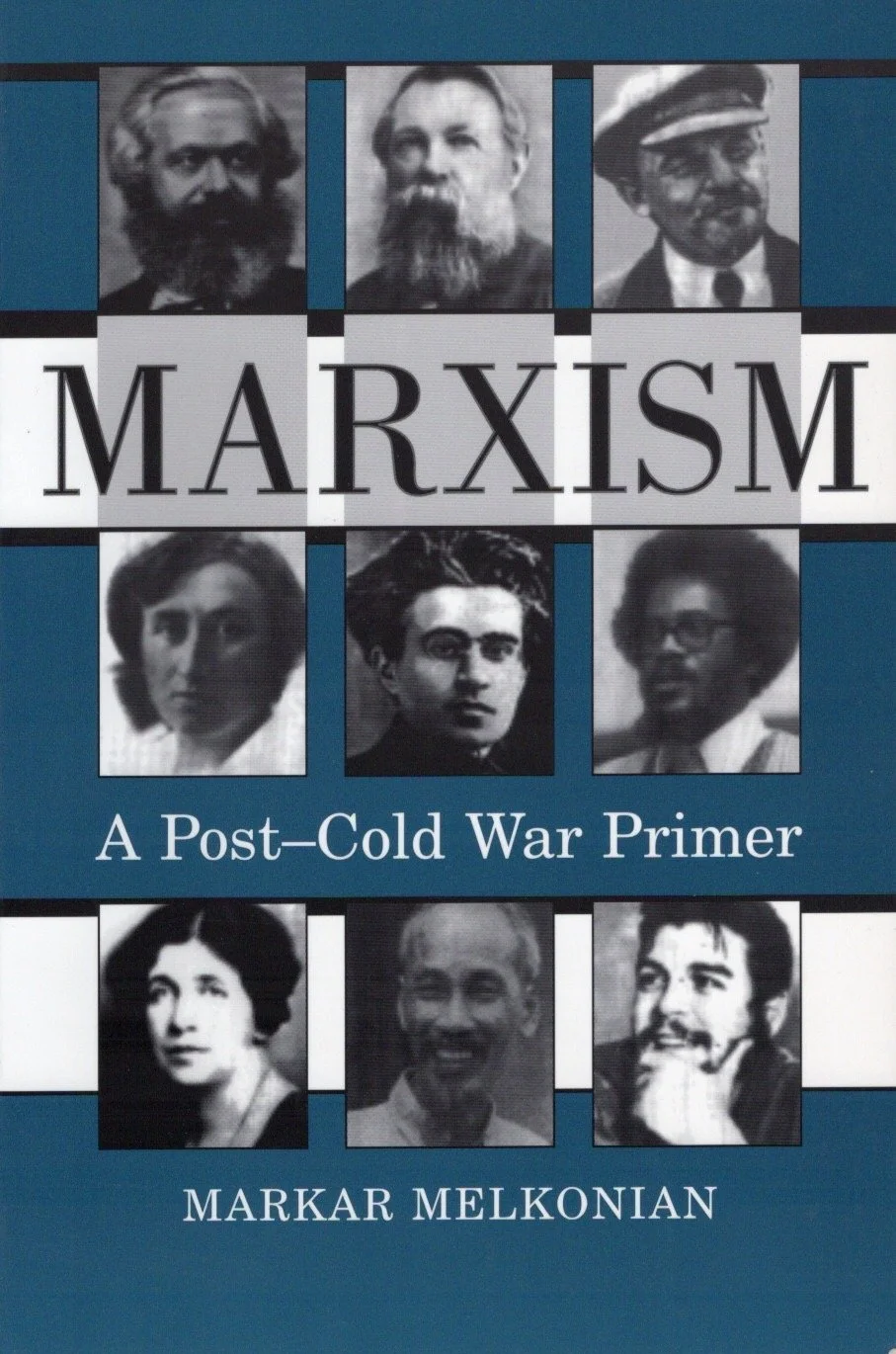
Marxism: A Post-Cold War Primer
Author: Markar Melkonian
Publication Information
Publisher: Westview Press
Publication Dates: 1994, 1996
Paperback ISBN: 0-8133-2886-1
Hardcover ISBN: 0-8133-2885-3
About The Book
Written for readers seeking a clear and accessible introduction to Marxist thought in the modern era, Marxism: A Post-Cold War Primer examines the historical foundations of Marxism while addressing contemporary political, economic, and social questions. Rather than treating Marxism as a relic of the twentieth century, the book explores its continuing relevance in a world shaped by globalization, inequality, war, and economic uncertainty.
Designed for students, general readers, and anyone interested in political ideas, the book explains key concepts, historical developments, and major debates in straightforward language. It seeks to move beyond common misconceptions and Cold War stereotypes by presenting Marxism as a living intellectual tradition that continues to influence discussions about democracy, capitalism, labor, social justice, and human freedom.
Combining historical analysis with contemporary examples, Marxism: A Post-Cold War Primer serves as both an introduction for newcomers and a useful reference for readers interested in understanding one of the most influential political and philosophical traditions of the modern era.
Key Topics Covered
Historical materialism
Class and capitalism
Marxist political theory
Social change
Labor and economic systems
Marxism after the Cold War
Reviews & Endorsements
"Admirably clear as well as philosophically interesting. Melkonian has produced an elegant primer sprinkled throughout with original insights and formulations that convey how Marxism functions as a social theory."
—Anatole Anton, San Francisco State University
A Few Words About How I Came To Write This Primer
I wrote The Weapon of Theory, the predecessor of Marxism: A Post-Cold War Primer, at the request of a small collective in San Francisco, of which I was a member in the last half of the 1980s. This project required explaining sophisticated ideas in language that would be as non-technical as I could get it. While writing the book, I imagined an audience of intellectually precocious high school students searching for solutions to problems posed by life and class struggle. Instructors who have used my primer as a college text have told me it is the best book of its kind available.
My research for the primer started long before 1993, when The Weapon of Theory first appeared. In the late 1980s and the early 1990s, both in the United States and the disintegrating Soviet Union, I encountered what appeared to be an almost-unanimous consensus, to the effect that Karl Marx was either wrong or irrelevant, or both. It seemed to me that I had heard the arguments against Marxism before; nevertheless, I noticed that many erstwhile Marxists had abandoned the tradition, and I was anxious to find out why. So I set out to sift through the claims and counter-claims of the most serious and best-thought-out critics of Marxism. I resolved to keep myself open to modifying my philosophical and political beliefs--or abandoning them entirely, if my research were to lead me in that direction. Over the course of a couple of years, I did indeed relinquish many of my former philosophical and political beliefs. I adopted new interpretations of past events and re-evaluated the lives and ideas of leaders and thinkers within the larger Marxist tradition.
The more closely I examined things, though, the more convinced I became that at least one version of Marxism-namely, the one I present in Marxism: A Post-Cold War Primer, was far superior to anything I had encountered from the best-known critics of Marxism. Furthermore, this version is immune to some well-known criticisms of "Marxism" conceived as a grand narrative (Lyotard), or a form of historical or technological determinism (Kolakowski, Castoriadis), or a variety of transcendental philosophy (Richard Rorty). I like to describe it as a lean, mean Marxism: On the one hand (the "lean" aspect), it is devoid of adventitious metaphysical hypotheses with which the various "Orthodox Marxisms" have been burdened; and on the other hand (the "mean" aspect), it focuses on the reality of such relations of domination as class conflict, exploitation, state power and imperialism.
As I prepared the primer for publication, many of the opponents of Marxism were in the process of discrediting themselves in the eyes of millions of their compatriots. The Free Marketeers of Eastern Europe and the former Soviet Union delivered misery and economic insecurity to the majority, along with new forms of political manipulation. The victors in the Cold War continued to spend trillions of dollars on armaments, while an ever-tighter global tyranny of capital descended upon Asia, Africa and Latin America. In the so-called "economic miracles" of Latin America, the Caribbean and the Pacific Rim, productivity and GDPs soared, even as hundreds of millions of people spiraled into deeper and deeper poverty. And in the United States, wages and working-class living standards continue to fall, even as stock markets boom. It would be easy to argue, then, that in the Twenty-First Century Marxism is more important than ever.
A Favorite Feature
What Is a Marxist? An Answer for a Six-Year-Old
Click the link below to print out a bookmark introducing Marxism for precocious pre-teens. After printing it out on regular typing paper, cut it out along the outer dotted lines, then fold along the inner dotted line, and voila, the bookmark.